
Finding the best progressive lenses in 2026 is easier and more exciting than ever. Progressive lenses – also called multifocal or no‑line lenses – let people with presbyopia see clearly at multiple distances without switching glasses. New technology means these lenses can now be customized to your eyes and lifestyle. This article breaks down what has changed in progressive lenses, the different types available, and how to choose the right pair for you. We’ll also look at the benefits, potential downsides, and frequently asked questions. Remember, this information is for education only; always talk with an optometrist or ophthalmologist if you have specific vision problems or need a prescription.
What Is Presbyopia and Why Do People Need Progressive Lenses?
Presbyopia is an age‑related refractive error that makes it hard for middle‑aged and older adults to see things up close. According to the National Eye Institute (NEI), presbyopia happens because the eye’s lens becomes harder and less flexible, so it stops focusing light correctly on the retina. People usually notice symptoms like holding reading materials farther away, eye strain and headaches. Presbyopia is a normal part of aging that typically begins after age 45. When presbyopia is combined with other refractive errors such as nearsightedness or farsightedness, you may need glasses that correct both near and distance vision.
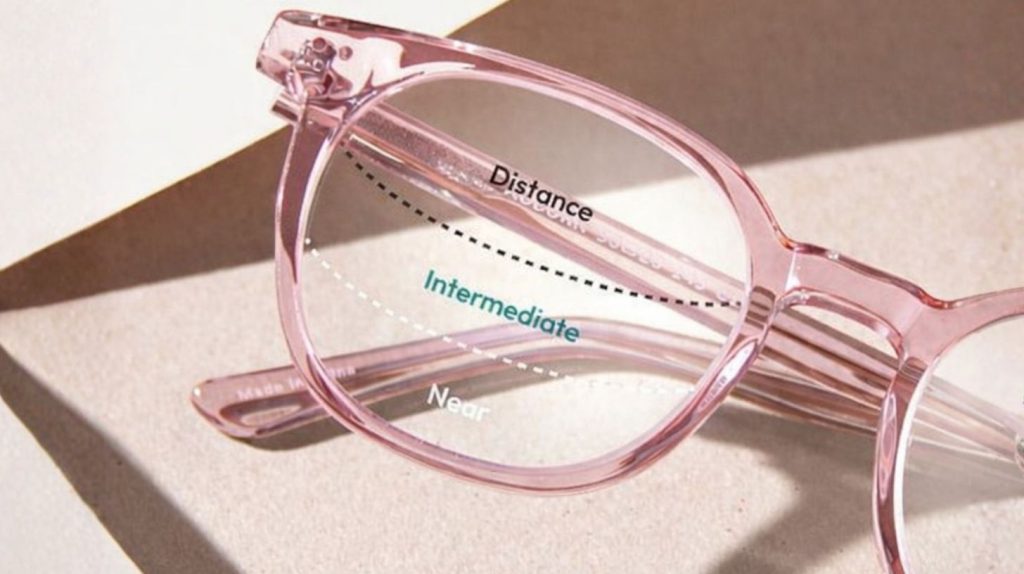
This is where progressive lenses come in. Progressive lenses are multifocal eyeglass lenses that provide more than one area of focus so you can see clearly at varying distances. The Cleveland Clinic notes that progressives give you three zones of vision – near, middle and far – in one lens without lines. They seamlessly blend these zones, so there isn’t a visible line between the prescriptions. Because presbyopia happens naturally to almost everyone, progressive lenses have become increasingly popular.
How Progressive Lenses Work
American Academy of Ophthalmology (AAO) describes progressive lenses as eyeglasses with a seamless increase in magnification from the top to the bottom of the lens. You look through the top portion of the lens to see far‑away objects, the middle to focus on intermediate tasks, and the bottom for reading or close‑up work. The prescription changes gradually across the lens surface, which avoids the “image jump” that people experience with bifocals and trifocals.
The NEI adds that progressive lenses are multifocal lenses that don’t have a visible line between the near and distance areas. They bend light to make it focus correctly on your retina so that you see clearly at different distances. This design reduces the abrupt changes in clarity found in older bifocal or trifocal lenses and provides a smoother visual experience.
Types of Progressive Lenses Available in 2026
Not all progressive lenses are the same. Manufacturers offer various designs tailored to different lifestyles. The Cleveland Clinic lists several types of progressive lenses:
- Computer (near variable focus) progressives: Designed for people who spend long hours at a computer, these lenses devote more space to intermediate distance and reduce eye strain. The AAO notes that computer glasses help reduce eye strain and make it easier to shift focus between tasks.
- Premium progressives: Custom‑made lenses that factor in which eye is dominant, your unique measurements and how the lenses fit your frame. Premium designs often use advanced digital surfacing technology to maximize viewing areas and minimize distortion.
- Ground‑view progressives: Built for people who spend a lot of time looking down, such as golfers. These lenses move the intermediate and near zones higher up to make looking down at the ground more comfortable.
- Standard progressives: These lenses aren’t customized; your provider doesn’t measure the distance between your eyes and the glasses aren’t tailored to your face. They’re often cheaper but may have smaller clear zones.
- Short‑corridor progressives: Designed for smaller frames, they have narrower corridors, which can lead to more peripheral blur.
- Transition (photochromic) progressives: These lenses darken automatically when exposed to ultraviolet light, giving you both multifocal and light‑adaptive capabilities in one pair.
New and Emerging Progressive Lens Technologies
While the types above have existed for years, 2026 sees continued innovation in lens design. Here are key developments shaping the best progressive lenses in 2026:
Free‑Form Digital Surfacing and Customization
Modern progressive lenses increasingly use free‑form digital surfacing. Instead of grinding lenses from a fixed mold, manufacturers use computer‑controlled machinery to carve prescriptions point‑by‑point. A randomized, double‑masked crossover trial published in Optometry and Vision Science compared customized free‑form progressive lenses with standard non‑free‑form lenses. In this study, 95 experienced wearers tested Zeiss Individual free‑form progressives and standard progressives for one week each. Participants preferred the free‑form lenses overall and rated them higher for distance, midrange and reading tasks. They also reported a wider field of undistorted vision in the reading zone and overall greater satisfaction. The study concluded that customizing lenses based on factors like back vertex distance, segment height, pantoscopic tilt and frame wrap angle can significantly improve comfort and vision.
Free‑form technology allows lens makers to tailor optical power smoothly across the entire lens surface, optimizing the corridor length and width for your prescription and frame. Wearers often experience clearer vision and less peripheral distortion compared with standard progressives.
Asymmetric Defocus and Next‑Generation Lens Design
A 2024 Frontiers in Physics study took the concept of free‑form surfaces further by designing asymmetric defocus freeform lenses. Researchers created a lens with two meridians (nasal and temporal) that vary optical power differently, providing an asymmetric distribution of additional power. To achieve a smooth transition between the central fixed‑focus zone and peripheral defocused zones, they incorporated a logistic regression function into the meridian design. Prototypes were manufactured and tested, revealing that controlling optical power this way can improve peripheral vision and comfort. Although technical, this research shows how academic and industry collaboration is pushing progressive lens design forward.
Artificial Intelligence and Smart Design
In 2026, some high‑end progressive lenses use artificial intelligence (AI) and big data to optimize the design. Lens manufacturers gather data from thousands of wearers – including prescription history, frame shape, pupillary distance and lifestyle – to generate individualized lens surfaces. AI helps predict how your eyes move across the lens and adjusts the corridor shape accordingly. While many advancements come from proprietary industry research rather than peer‑reviewed publications, the underlying principle is to create smoother transitions and wider fields of clear vision.
Digital Device‑Friendly Designs
With people spending more time on screens, computer and office progressives have become more refined. These lenses devote larger portions of the lens to intermediate distances (about 50–70 cm) to make looking at screens comfortable. They often include blue‑light‑filtering coatings and anti‑glare treatments, which can reduce digital eye strain. Although not medical cures, these features align with 2026’s emphasis on eye comfort in a digital world.
Benefits of Progressive Lenses

Choosing progressive lenses provides several advantages:
- One pair for all distances: Progressive lenses combine prescriptions for near, intermediate and far vision in one lens, so you don’t need separate reading or driving glasses.
- Cosmetic appeal: Progressives lack the visible lines found in bifocals or trifocals, making them more discreet and modern.
- Reduced eye strain and no image jump: The smooth transition between viewing zones avoids abrupt shifts in image size or clarity, which can cause eyestrain and headaches. The continuous lens surface also reduces “image jump” seen in traditional multifocals.
- Convenience and lifestyle fit: Premium and customized progressive lenses can be tailored to your daily activities. Computer progressives allocate more space to intermediate vision, while ground‑view lenses help people who look downward frequently.
- Adaptable to changing prescriptions: Many progressive lenses come in photochromic or transition options that adjust to sunlight, and some incorporate coatings to protect against blue light.
Potential Drawbacks and Considerations
No lens solution is perfect. Here are some potential disadvantages to consider:
- Cost: Progressive lenses are more expensive than single‑vision or bifocal lenses. The AAO notes that cost is higher because creating a lens with multiple prescriptions and no lines requires extra time and technology. Premium and customized options cost even more.
- Limited frame choice: Because progressive prescriptions must be placed precisely within the lens, there are fewer frame shapes and sizes to choose from. Short‑corridor lenses for small frames may have narrower clear zones.
- Peripheral distortion: During the adaptation period, wearers may notice peripheral blurring or feel off‑balance when moving eyes from side to side. This is because the sides of the lenses contain blended prescriptions.
- Learning curve and adaptation time: You need to train yourself to look through the correct part of the lens for different tasks. The AAO says adaptation may take from a week to a couple of months, and you may feel off‑balance or nauseated at first. Proper fitting and consistent wear can reduce adjustment time.
- No universal fix: Some people never fully adapt to progressives and may return to bifocals or trifocals. If you experience headaches or persistent discomfort, consult your eye care provider.
How to Choose the Best Progressive Lenses in 2026
Selecting the right progressive lens depends on your prescription, lifestyle and budget. Here are step‑by‑step considerations:
- Get a comprehensive eye exam: Always start with a professional exam. Eye doctors can diagnose presbyopia and other refractive errors and provide the correct prescription.
- Discuss your lifestyle: Tell your optometrist how you spend your days – office work, outdoor activities, driving, reading, etc. This helps determine whether you’d benefit from computer progressives, ground‑view lenses or standard designs.
- Consider customization: Free‑form digital lenses offer the most tailored fit. They account for your pupil distance, frame wrap, tilt and viewing habits, resulting in wider clear zones and better comfort.
- Choose the right frame: The frame shape affects how well the progressive design works. Some frames are too small for standard corridors; in such cases, short‑corridor lenses are necessary.
- Ask about coatings and materials: Anti‑reflective coatings, blue‑light filters and photochromic technology can improve comfort. Lightweight high‑index materials reduce lens thickness for stronger prescriptions.
- Budget wisely: Decide how much you’re willing to spend. Premium and customized progressives cost more but often provide a better visual experience.
- Plan for adaptation: Wear your progressives consistently and move your head rather than your eyes when changing focus. Point your nose toward objects and adjust your chin up or down until the object appears clear. Give yourself at least a couple of weeks before deciding whether they work for you.
Everyday Tips for Living With Progressive Lenses
Adjusting to progressive lenses doesn’t have to be difficult. Use these practical tips to make the transition smoother:
- Practice looking through each zone. While walking or climbing stairs, look through the top part of your lenses for distance. Use the middle for computer screens and dashboards, and the bottom for reading.
- Move your head, not just your eyes. Progressive lenses work best when you face objects directly. Turn your head slightly instead of sliding your eyes side to side.
- Start with light activities. Wear your new lenses during easier tasks like watching TV or reading a magazine before using them for more complicated activities.
- Give it time. Your brain and eyes need time to adapt. Some people adjust within a week, while others may need a month or more.
- Seek help if issues persist. If you continue to feel dizzy, see halos or get headaches, contact your eye care professional. They can verify the prescription or adjust the frame.
What’s New in 2026?
The year 2026 doesn’t reinvent progressive lenses but builds on recent innovations:
- More affordable customization: Advances in free‑form manufacturing have reduced costs, making personalized progressives more accessible. Mid‑range options now include some level of customization, offering better performance than standard lenses without the high price of premium models.
- AI‑driven designs: Some manufacturers use artificial intelligence to analyze wearers’ data and refine lens corridors. This leads to smoother transitions and wider viewing zones tailored to your daily habits.
- Enhanced digital coatings: Blue‑light‑filtering and anti‑reflective coatings have improved to block a broader range of wavelengths while preserving color accuracy. Coatings now last longer and are easier to clean.
- Sustainable materials: Several brands have introduced lenses made from recycled plastics and biobased materials, aligning with broader environmental initiatives. While this doesn’t directly affect vision, it appeals to eco‑conscious consumers.
- Augmented reality compatibility: As smart glasses become more common, progressive lens manufacturers are experimenting with integrating prescription lenses into heads‑up displays. While still early, 2026 sees prototypes that combine progressive optics with digital overlays.
Frequently Asked Questions (FAQs)
- What makes progressive lenses different from bifocals?
Progressive lenses provide a gradual, seamless change in prescription from the top to the bottom of the lens, whereas bifocals have two distinct lens powers separated by a visible line. The smooth transition in progressives eliminates the “image jump” common in bifocals. - Are progressive lenses suitable for everyone?
Most people with presbyopia and other refractive errors can wear progressives, but not everyone adapts easily. Some may prefer bifocals or single‑vision glasses. An eye care professional can help determine whether progressives suit your vision and lifestyle. - How long does it take to get used to progressive lenses?
Adaptation time varies. The AAO says it can take anywhere from one week to a couple of months to adjust. Wearing them consistently and having them properly fitted can reduce adjustment time. - What is the difference between free‑form digital and standard progressive lenses?
Free‑form digital progressives are custom‑designed using computer‑controlled surfacing to match your prescription and frame measurements. Studies show that customized free‑form lenses provide a wider field of clear vision and higher wearer satisfaction compared with standard non‑free‑form lenses. - Can progressive lenses be made with photochromic or blue‑light‑filtering features?
Yes. Many progressive lenses now include photochromic technology that darkens in UV light, as well as coatings that filter blue light and reduce glare. These options can make lenses more versatile and comfortable for screen use. - Do progressive lenses weaken your eyes?
No. Progressive lenses help you see clearly while you wear them but do not change your eyes themselves. The NEI notes that glasses make vision clearer but don’t make your eyes weaker or worse. - When should I talk to an eye doctor about progressive lenses?
If you’re noticing trouble reading up close, holding things farther away, or experiencing eye strain and headaches, schedule an exam. Presbyopia is a normal part of aging, and a professional can recommend whether progressive lenses, bifocals or another solution is best.
Conclusion
Progressive lenses have come a long way. In 2026, the best progressive lenses offer smoother transitions, wider viewing zones and better customization than ever before. Free‑form digital surfacing, AI‑driven designs and specialized coatings make them more comfortable and versatile. However, they still require a period of adaptation and can be more expensive than other lenses. Understanding the types available and working with your eye care professional will help you find the right pair. If you’re experiencing signs of presbyopia, schedule a comprehensive eye exam and explore whether progressive lenses could improve your vision and quality of life.
