

Seeing two copies of one object can be frightening. Is it a glasses problem, tired eyes, or something more serious?
The possible causes of double vision range from dry eye and astigmatism to eye misalignment, nerve problems, and neurological illness. Some causes are limited to one eye. Others affect how both eyes work together.
New double vision should not be self-diagnosed. Sudden symptoms, especially with weakness, severe headache, or trouble speaking, require emergency care.
One simple observation can help your doctor: does the extra image remain when either eye is covered? That separates the two main types of double vision.
What does double vision look like?

Double vision is also called diplopia. You may see two clear copies or one main image with a lighter shadow. The images can sit side by side, one above the other, or diagonally.
Some people only see double while looking far away. Others notice it during reading, when looking in one direction, or late in the day. It may be constant or come and go.
Monocular double vision remains when the affected eye looks alone. Binocular double vision disappears when either eye is covered.
This distinction is useful, but it is not a diagnosis. Do not press on the eye or repeat the check while driving or walking.
Monocular versus binocular double vision
To describe the pattern safely, sit still and look at one object. Cover one eye without pressing it, then switch sides.
If the double image stays when one particular eye is open alone, it is monocular diplopia. This usually points to how light travels through that eye. The tear film, cornea, natural lens, or retina may be involved.
If the double image appears only with both eyes open, it is binocular diplopia. The eyes are sending images that do not line up. Covering either eye removes one image, so the doubling stops.
Binocular diplopia can come from an eye alignment, muscle, nerve, or brain problem. A clinical overview of monocular and binocular diplopia explains why the distinction changes the evaluation.
Even if covering one eye stops the symptom, do not assume the cause is minor. Sudden binocular double vision can require urgent medical assessment.
8 common causes of double vision
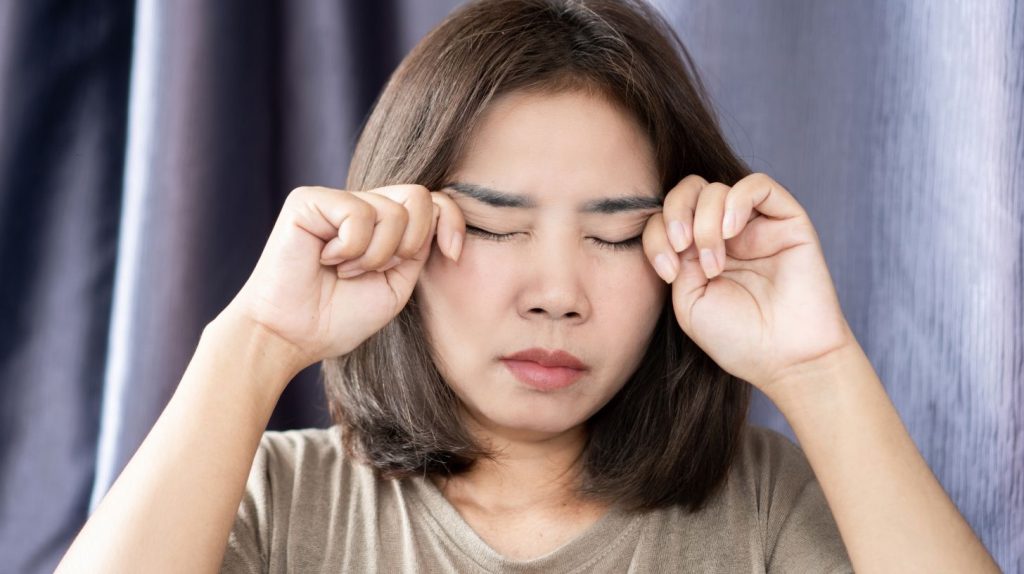
The following categories explain many cases, but they cannot identify the cause of an individual symptom. More than one problem may be present at the same time.
1. Dry eye and an uneven tear film
Every blink spreads a thin tear layer over the cornea. This smooth surface helps light enter the eye evenly.
When tears break up too quickly, the surface becomes irregular. Text may smear, lights may produce shadows, and a faint second image may appear. This is usually monocular ghosting rather than two equally clear images.
Dry-eye blur often changes after blinking. Burning, grittiness, watering, or contact-lens discomfort may occur too. However, blinking improvement does not prove that dryness is the only cause.
Air conditioning, long screen sessions, contact lenses, eyelid problems, and some medicines may worsen dryness. An eye professional can check the tear film and corneal surface before suggesting treatment.
Do not assume that every lubricating drop is suitable for frequent use. Ask an optometrist or ophthalmologist about persistent symptoms, especially if the eye is painful or very red.
2. Astigmatism or an irregular cornea
Astigmatism means the eye does not focus light evenly. An outdated or incomplete astigmatism correction may create blur, streaks, or a shadow beside letters.
Some corneas have a more irregular shape. Keratoconus, corneal scars, previous surgery, or contact-lens warping can make several light patterns reach the retina. The result may remain when the other eye is covered.
An eye exam can separate ordinary refractive blur from a corneal condition. Refraction measures the lens power that gives the clearest view. Corneal topography maps the front surface when more detail is needed.
Readers can review how astigmatism changes the way light focuses for a clearer explanation of regular and irregular astigmatism.
New glasses may solve a simple prescription problem. They may not fully correct a highly irregular cornea, which can require specialty contact lenses or other care.
3. Cataracts or another lens problem
The natural lens sits behind the colored part of the eye. A cataract forms when that lens becomes cloudy.
Clouding can scatter light and split an image within one eye. People may also notice glare, halos, faded colors, or difficulty at night. Early changes can affect one eye more than the other.
Monocular double vision from a cataract remains when the clearer eye is covered. It may change with lighting or pupil size.
A shifted natural lens can also cause double or distorted vision. Lens movement is less common and may follow injury or occur with certain connective-tissue conditions.
An ophthalmologist can examine the lens with a slit lamp. Cataract surgery is considered when the clouding affects daily activities and the expected benefits outweigh the risks. Double vision still needs a full evaluation because a cataract may not be the only problem.
4. Strabismus or a hidden eye alignment problem
Strabismus means the eyes do not point in the same direction. One may turn inward, outward, upward, or downward.
Some people have had an eye turn since childhood. The brain may have learned to ignore one image, so they do not see double. If alignment changes later, two images can appear.
Others have a small tendency for the eyes to drift, called a phoria. The visual system normally keeps the eyes together. Illness, fatigue, aging, or a new prescription may make that control less effective.
Binocular double vision from misalignment disappears when either eye is covered. It may be worse in one viewing direction or at a certain distance.
An eye professional measures alignment at near and far. Treatment depends on the pattern and may include prescription changes, prism, selected exercises, or eye-muscle surgery. Exercises are helpful for specific alignment disorders, not every form of diplopia.
5. Convergence insufficiency during close work
The eyes must turn inward, or converge, to view a nearby object. Convergence insufficiency means they have difficulty maintaining that inward position during close work.
Words may split, move, or blur while reading. Other symptoms include eye strain, headache, losing your place, and closing one eye. Problems often grow worse during a long reading or computer session.
This is a form of binocular difficulty. The doubling usually stops if either eye is covered. It may not appear during distance viewing.
A routine distance eye chart cannot fully evaluate convergence. Testing may include how the eyes align at near, how close they can converge, and how well they maintain alignment.
Evidence-based treatment may involve supervised vergence exercises or other care selected after an examination. Buying random “eye exercise” programs online can delay the correct diagnosis.
6. A cranial nerve palsy
Several nerves carry instructions from the brain to the eye muscles. Weakness in one of these nerves can stop the eyes from moving together.
This is called a cranial nerve palsy. The double images may be horizontal, vertical, or diagonal. They often separate more when the person looks in a particular direction.
Diabetes, high blood pressure, inflammation, injury, and other conditions can affect these nerves. Sometimes the cause is not clear at the first visit. Age, symptoms, examination findings, and medical history guide the testing.
A drooping eyelid, enlarged pupil, severe headache, or new neurological symptom raises more concern. Sudden double vision should receive prompt assessment rather than waiting for a routine glasses appointment.
Temporary management may include covering one eye or using a removable prism under professional direction. Those steps reduce the second image but do not treat the cause.
7. Thyroid eye disease or myasthenia gravis
Some illnesses affect the eye muscles or the signals that control them. Two important examples are thyroid eye disease and myasthenia gravis.
Thyroid eye disease can make the tissues and muscles around the eyes swell or tighten. The eyes may become misaligned. Other clues include bulging, eyelid swelling, redness, grittiness, or pain with eye movement.
The condition often occurs with Graves’ disease, but thyroid hormone levels do not predict every eye symptom. An authoritative guide to thyroid eye disease and double vision explains how restricted muscles can affect alignment.
Myasthenia gravis interrupts communication between nerves and muscles. Eye symptoms may include double vision or a drooping eyelid that changes during the day. Weakness elsewhere can also occur.
Breathing trouble, choking, or rapidly increasing weakness is an emergency. These disorders need medical evaluation and should not be managed with glasses alone.
8. A neurological condition, stroke, or head injury
The brain coordinates eye position and turns two images into one view. Disease or injury along those pathways can cause binocular diplopia.
Possible causes include stroke, multiple sclerosis, aneurysm, a brain mass, infection, migraine-related conditions, and head trauma. These do not all have the same likelihood or urgency. Some are uncommon, but they matter because delay can be dangerous.
Double vision after a head injury needs prompt medical advice. Do not return to driving, sports, or hazardous work until a qualified clinician says it is safe.
Sudden diplopia with facial drooping, arm weakness, numbness, trouble speaking, confusion, severe imbalance, or an intense new headache may signal a stroke or another emergency. Call emergency services rather than driving yourself.
A professional review of when binocular diplopia may signal an intracranial problem outlines why associated neurological signs change the level of concern.
Can tiredness, alcohol, or medicines cause double vision?

Tiredness can make a small alignment problem harder to control. A person may only notice double vision at night or after long close work. Fatigue is therefore sometimes a trigger rather than the full cause.
Alcohol can reduce coordination and temporarily affect eye movements. Sedatives, anti-seizure medicines, and other drugs may also contribute to blur or diplopia in some people.
Do not stop prescribed medicine suddenly. Record the medicine name, dose, and timing of symptoms, then contact the prescriber. Seek urgent help if symptoms are severe or occur with weakness, breathing trouble, confusion, or loss of consciousness.
Repeated double vision should not be dismissed as lack of sleep. An exam is needed to check whether fatigue is revealing an underlying alignment or neurological problem.
When is double vision an emergency?
Sudden double vision deserves prompt medical attention, even without pain. The urgency rises when another neurological or eye symptom appears.
Call emergency services for sudden double vision with:
- Weakness or numbness on one side
- Facial drooping or trouble speaking
- Severe imbalance, fainting, or confusion
- A sudden, unusually severe headache
- A new unequal or enlarged pupil
- A drooping eyelid with headache or eye pain
- Recent significant head trauma
- Trouble swallowing or breathing
Severe eye pain, a red eye, nausea, halos, and reduced vision can also indicate an eye emergency. Seek immediate assessment.
Do not drive while seeing double. Covering one eye may remove the second image, but it also reduces depth perception and side awareness.
How doctors investigate the causes of double vision
The clinician will first ask when the symptom began and whether it is constant. Describe whether the images are side by side, vertical, or diagonal.
They may also ask:
- Does covering either eye make the doubling stop?
- Is it worse at near or far?
- Does it change with gaze direction or head position?
- Is one eyelid drooping?
- Did it follow an injury, illness, or medicine change?
- Do you have diabetes, high blood pressure, thyroid disease, or neurological symptoms?
The examination may include visual acuity, refraction, pupil reactions, eye movements, alignment measurements, and a slit-lamp examination. The retina and optic nerves may also be checked.
Blood tests, imaging, or neurological evaluation are not required in every case. They are ordered when the history and examination suggest a need.
Bring old photographs if an eye turn or eyelid change may have existed before. A current medicine list and details about health conditions also help.
How double vision may be treated
Treatment depends completely on the cause. A strategy that helps dry-eye ghosting will not correct a nerve palsy or stroke.
Possible approaches include:
- Updated glasses or specialty contact lenses for certain optical causes
- Clinician-recommended dry-eye treatment
- Cataract surgery when a cataract is responsible and surgery is appropriate
- Prism in glasses to move images closer together
- Temporary covering or fogging of one lens
- Targeted exercises for selected eye-teaming disorders
- Treatment of diabetes, thyroid disease, inflammation, or another underlying illness
- Eye-muscle surgery for some stable alignment problems
Prism bends light so the images are easier to combine. It does not strengthen a weak nerve or cure the condition causing misalignment. The site’s guide to prism values on an eyeglass prescription explains how this correction appears on a prescription.
Alignment can change while a condition heals or progresses. Doctors may begin with a temporary press-on prism before ordering permanent prism lenses.
No treatment can promise to restore single vision in every case. Benefits, limitations, and risks should be discussed with the relevant eye or medical specialist.
What to do while waiting for an appointment
Stop driving and avoid ladders, machinery, or other activities that depend on accurate depth perception. Ask someone else to provide transport.
Write down when the doubling started and what makes it change. Note whether it disappears when either eye is covered. Include related symptoms such as headache, weakness, drooping, pain, or dizziness.
Do not begin eye exercises or use someone else’s prism glasses. A prism made for another alignment pattern can worsen discomfort.
If symptoms are sudden or any emergency signs develop, do not wait for a routine appointment. Seek urgent care.
A practical takeaway
The causes of double vision include problems with the tear film, cornea, lens, eye alignment, muscles, nerves, and brain. The one-eye cover observation helps separate monocular from binocular diplopia, but it cannot provide a diagnosis.
Arrange an eye or medical assessment for new, repeated, or unexplained symptoms. Seek emergency help for sudden double vision with weakness, speech trouble, severe headache, pupil changes, or head injury.
Until the cause is understood, put safety first. Do not drive, and do not assume that new glasses alone will solve the problem.
Frequently asked questions
What are the most common causes of double vision?
Common causes of double vision include dry eye, astigmatism, corneal irregularity, cataracts, and eye misalignment. Binocular double vision may also come from convergence problems, a cranial nerve palsy, thyroid eye disease, or a neurological condition. A professional examination is needed because several causes can produce similar symptoms.
Why does double vision disappear when I cover one eye?
If covering either eye removes the second image, the problem is binocular. The two eyes are producing images that do not align. Possible reasons include strabismus, convergence insufficiency, muscle restriction, or a nerve problem. Sudden binocular symptoms should receive prompt medical attention, especially with headache or neurological changes.
Can dry eye really make me see two images?
Yes. An unstable tear film can create a faint shadow or ghost image within one eye. It may shift or improve after blinking. However, dry eye is not the only cause of monocular doubling. Cataracts, astigmatism, and corneal irregularity can look similar, so persistent symptoms deserve an eye examination.
Can an incorrect glasses prescription cause double vision?
An inaccurate astigmatism correction, poorly centered lenses, or an unsuitable prism can cause blur, distortion, or doubling. A large prescription difference between the eyes may also be difficult to combine. New double vision should not automatically be blamed on glasses because eye and neurological conditions can produce the same complaint.
Are prism glasses a permanent cure for diplopia?
No. Prism glasses bend light to help the two images line up, but they do not cure the underlying cause. They work better for some stable alignment patterns than others. A temporary prism may be used while alignment changes. An optometrist or ophthalmologist must measure the direction and amount carefully.
Can stress or fatigue cause double vision?
Fatigue can reduce the ability to control a small eye alignment tendency. Symptoms may then appear late in the day. Stress can also worsen awareness of discomfort. Still, repeated diplopia should not be labeled as stress without an examination. Fatigue may be exposing a treatable eye-teaming or medical problem.
Should I go to the emergency room for sudden double vision?
Sudden double vision needs urgent assessment. Call emergency services when it occurs with weakness, numbness, facial drooping, speech trouble, severe imbalance, a major headache, pupil changes, a drooping eyelid, or recent head injury. Do not drive yourself. Even without those signs, seek prompt medical advice for unexplained sudden diplopia.
