

Unlocking the Code on Your Eye Prescription

Do you remember the first time you saw the printout from your eye exam? Maybe it looked like an algebra equation. You might have seen abbreviations like OD, OS, SPH or CYL and wondered whether you were supposed to understand them. The truth is, most of us leave the doctor’s office trusting that the optician knows how to fill the prescription correctly. Yet learning to read your own eyeglass prescription can be empowering. It helps you double‑check orders, ask informed questions, and know when it’s time for an update.
In this article we’ll break down the abbreviations and numbers on your prescription in plain English. You’ll learn what each field means, why it matters, and how to interpret your pupillary distance (PD). We’ll also explain differences between glasses and contact‑lens prescriptions and highlight common mistakes to watch for. Throughout, we reference information from trusted sources such as the American Academy of Ophthalmology and the U.S. Department of Veterans Affairs to ensure accuracy.
Understanding the Basics: OD, OS and OU
The first step in deciphering your prescription is learning which eye is which. In many countries eye doctors use Latin abbreviations:
- OD (Oculus Dexter) – This stands for right eye. The Healthline medical team explains that the abbreviation simply means “right eye” in Latin. Some modern prescriptions label this eye as RE.
- OS (Oculus Sinister) – This stands for left eye. Likewise, it is the Latin term for “left eye”. In some cases it may be labeled LE.
- OU (Oculus Uterque) – Less commonly used, this stands for both eyes. It is sometimes included when a prescription applies equally to both eyes.
Knowing which column refers to which eye ensures you match each number to the correct lens when ordering glasses. If your prescription uses RE and LE instead of OD and OS, they mean the same thing.
Sphere (SPH): Measuring Nearsightedness and Farsightedness
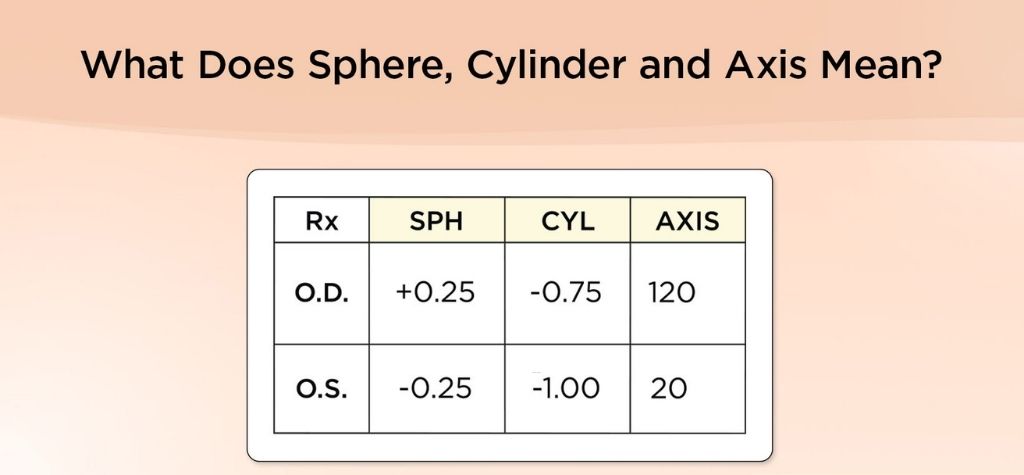
The sphere (SPH) column tells you the basic lens power needed to correct your distance or near vision. According to the American Academy of Ophthalmology (AAO), the SPH number is measured in diopters and indicates the lens strength required to focus light correctly on your retina. Here’s what you need to know:
- Minus sign (−) – If you see a minus sign before the number, you are nearsighted. That means you see better up close and need help focusing on distant objects.
- Plus sign (+) – A plus sign indicates you are farsighted. Farsighted people see better far away and need additional power for close‑up tasks.
- Zero (0 or Plano) – A sphere value of zero (sometimes written as “PL” for plano) means you do not need distance correction.
- Magnitude – The farther the number is from zero, the stronger your prescription. A sphere of −1.00 D (diopters) is mild myopia, while −9.00 D is considered high myopia.
Example
If your prescription reads OD −2.50 and OS −3.00, both eyes are nearsighted. The left eye requires slightly more negative power (−3.00 D) than the right (−2.50 D) to bring distant images into focus.
Cylinder (CYL) and Axis: Correcting Astigmatism
Many people have an astigmatism, meaning the cornea is more oval or football‑shaped rather than perfectly round. This causes light rays to focus at multiple points, leading to blurred or distorted vision. Astigmatism is corrected by adding a cylindrical component to the lens.
- Cylinder (CYL) – This number measures how much astigmatism you have. The AAO notes that the cylinder number shows the amount of extra power needed to correct the eye’s second curve. A larger absolute value means more astigmatism.
- Axis – The axis indicates where on the cornea the astigmatism is located. It is measured in degrees from 1 to 180. Think of it like the orientation on a compass. According to the AAO, the axis shows which way the astigmatism lines up. Without a cylinder value, there is no axis.
How to Interpret CYL and Axis
Suppose your prescription has CYL −1.25 and Axis 180 for the right eye. The negative cylinder means you need 1.25 diopters of extra power to correct an oval‑shaped cornea. The axis at 180 degrees shows the location of the astigmatism. Eye doctors always list the axis between 1 and 180 degrees; there is no plus or minus for axis because it refers to direction, not power.
If no cylinder or axis numbers appear, it typically means you have little or no astigmatism to correct.
Add: Power for Reading and Multifocal Lenses
As we age, the lens in our eye naturally stiffens, making it harder to focus up close. This condition, called presbyopia, often becomes noticeable in our 40s. If you need extra magnification for near work, your doctor will include an Add value on your prescription. The AAO explains that the Add column lists additional lens power for the bottom part of bifocals or progressive lenses.
Key points about Add:
- Add values are always positive numbers, usually between +0.50 and +3.00 diopters.
- They are the same for both eyes in most cases, even if your distance prescription differs.
- Add is only used for multifocal lenses; single‑vision distance or reading glasses will not list an Add value.
Prism: Aligning Images for Double Vision
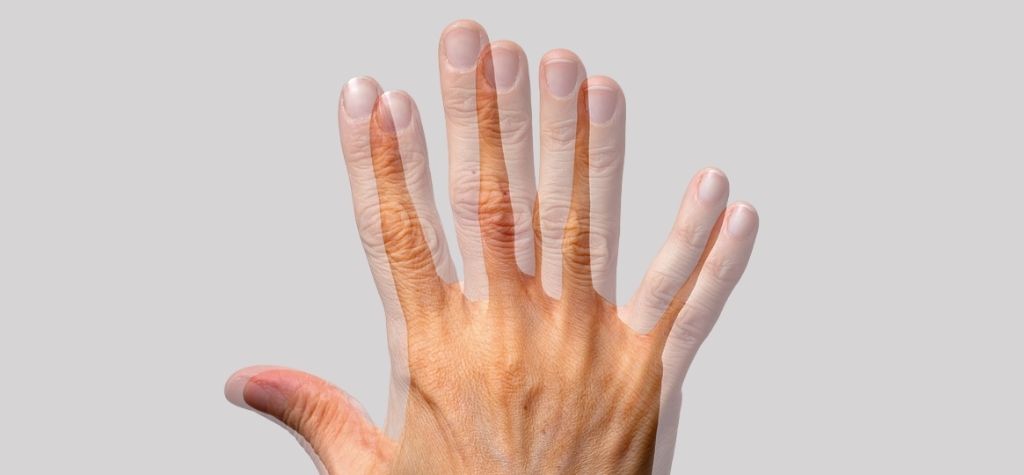
Some people experience double vision or eye misalignment. To help the eyes work together, a prescription may include a prism measurement. A prism bends light to compensate for eye alignment problems. The AAO notes that prism is a special correction built into lenses for people with double vision, helping them fuse two images into one. Prism prescriptions include both:
- Prism magnitude – Measured in prism diopters (pd), showing how much the light needs to bend.
- Base direction – Indicating where the prism’s thickest edge is placed (e.g., base up, base down, base in, base out).
Because prism corrections are less common, many prescriptions omit this field entirely. If you see a prism value, it is crucial to fill it correctly as small errors can cause significant discomfort.
Pupillary Distance (PD): Why Eye Alignment Matters
While many prescriptions list only the lens power, your pupillary distance (PD) is equally important when ordering glasses. PD is the distance between the centers of your pupils, measured in millimeters. The U.S. Department of Veterans Affairs describes PD as the measurement “between the centers of the pupils of the eyes” and explains that it ensures “the center of the lens… sits directly in front of your pupil”. Proper PD keeps the clearest part of the lenses aligned with your line of sight, optimizing vision and reducing eye strain.
Types of PD
- Distance PD – Measured when you look at far objects. This is the number most often used for everyday glasses.
- Near PD – Slightly smaller, used for reading glasses or computer lenses. It is typically 3 mm less than your distance PD.
- Monocular PD – Measurements for each eye separately when one eye may not be centered equally on the nose.
PD varies from person to person and can range roughly from 54 mm to 74 mm for adults. Children’s PD is often narrower. An accurate PD is essential for high‑power or progressive lenses, as even small misalignments can cause distortion or headaches.
How to Measure PD at Home
Many optometrists include PD on your written prescription, but not all. If it’s missing or if you are ordering glasses online, you can measure PD yourself using a millimeter ruler. The VA offers this step‑by‑step method:
- Stand about eight inches from a mirror and hold a millimeter ruler against your brow.
- Close your right eye and align the ruler’s “0 mm” over the center of your left pupil.
- Without moving the ruler, open your right eye and close the left. The millimeter mark aligned with the center of your right pupil is your binocular PD.
- For greater accuracy, have a friend take the measurements or repeat them three times and average the results.
If you wear progressive or bifocal lenses, your eye care provider may also measure the vertical distance from your pupil to the bottom of the frame. This ensures the reading portion of the lens sits at the correct height.
Why Your Glasses Prescription Differs from Your Contact Lens Prescription

Many people are surprised to learn that the numbers on their contact lens prescription differ from their glasses prescription. This is not a mistake. Glasses sit about 12 millimeters away from your eyes, whereas contact lenses rest directly on the cornea. Healthline notes that a contact lens prescription includes additional parameters—lens diameter, base curve, and specific brand—because the lens must fit your eye’s surface.
Your eye doctor may also adjust the lens power for contacts. For higher prescriptions, the effective power of the lens changes when it is closer to the eye. This adjustment ensures you receive the same focusing effect with contacts as you do with glasses. Never use your glasses prescription to order contact lenses without a proper fitting.
Reading Example: Putting It All Together
Let’s look at a sample prescription and interpret each part:
| Eye | SPH | CYL | Axis | Add | Prism |
|---|---|---|---|---|---|
| OD | −2.50 | −0.75 | 180 | +1.50 | 0.5Δ Base Out |
| OS | −3.00 | −1.00 | 175 | +1.50 | 0.5Δ Base Out |
- OD (right eye) SPH −2.50 – You are moderately nearsighted in the right eye.
- CYL −0.75, Axis 180 – You have a moderate astigmatism oriented horizontally at 180 degrees.
- Add +1.50 – The lower part of your lens provides 1.50 diopters of additional power for reading.
- Prism 0.5Δ Base Out – A small prism shifts the image slightly outward to align your eyes.
The left eye is similar but slightly stronger: −3.00 SPH for myopia and a bit more astigmatism.
Understanding the numbers helps you verify orders and discuss options—like whether you want single‑vision lenses, progressives, or specialized coatings.
Common Mistakes and How to Avoid Them
Even with a correct prescription, ordering glasses can go wrong. Here are common pitfalls and how to sidestep them:
1. Mixing Up Right and Left Eyes
It’s easy to misread OD and OS if you’re not paying attention. Always double‑check that you’ve entered each number into the correct column when ordering glasses online. Remember, OD = right eye, OS = left eye.
2. Ignoring Astigmatism or Axis
If your prescription lists a cylinder and axis, don’t leave them blank. Astigmatism corrections are crucial for crisp vision and comfort. Missing or mis‑typed values can lead to blur, headaches and eye strain.
3. Forgetting Pupillary Distance
Some opticians omit PD on the written prescription. However, proper lens alignment depends on it. Measure your PD or ask your eye doctor to provide it; the Veterans Affairs guide notes that accurate PD helps “optimize your viewing experience and reduces eye strain”.
4. Using a Glasses Prescription for Contacts
As noted earlier, contact lenses require different parameters and sometimes a different power. Do not use your glasses prescription to order contacts. Get a separate fitting and prescription.
5. Not Updating Your Prescription Regularly
Vision changes over time due to age, health conditions or daily activities. Healthline recommends having a comprehensive eye exam every year or two. Even if you think you see fine, a new prescription can reduce strain and prevent headaches.
Additional Tips for Ordering Glasses
- Frame Size and Fit – Choose frames that fit your face comfortably and align well with your eyes. A poor fit can cause the lenses to sit off‑center, reducing their effectiveness.
- Lens Material – High‑index plastic, polycarbonate, and Trivex lenses offer lighter weight and greater impact resistance. Consider your prescription strength, lifestyle and budget.
- Coatings – Anti‑reflective coatings reduce glare; blue‑light filters may help with digital eye strain; and photochromic lenses darken outdoors for convenience.
- Try a Virtual Try‑On – Many retailers offer virtual try‑on tools. Use them to see how different frames look before ordering.
- Read Reviews and Return Policies – Choose a reputable retailer and understand the return or remake policy in case adjustments are needed.
Conclusion: Empower Yourself Through Knowledge
Reading your eye prescription may seem daunting at first, but understanding the abbreviations and numbers empowers you to take charge of your vision care. With a little practice you can decode OD and OS, know whether you’re nearsighted or farsighted, understand your astigmatism correction, and check your Add and prism values. Measuring your pupillary distance ensures that your lenses are centered correctly, reducing strain and improving clarity.
Having this knowledge helps you communicate better with your eye care provider and make informed choices when ordering glasses. It also allows you to recognize when something might be wrong—whether it’s a misaligned lens, an outdated prescription or an overlooked PD measurement. As your eyes continue to change throughout life, keep this guide handy for your next exam. With the right information, you can read your eye prescription like a pro and enjoy clear, comfortable vision every day.
