
Imagine slipping a contact lens onto your eye that not only corrects your vision but also measures your blood sugar, monitors glaucoma, treats dry eye and projects digital information right onto your retina. Tech enthusiasts have long promised this future, but where are those smart contact lenses now? This article explores the current state of the technology, the challenges innovators face, and realistic expectations for when these lenses might become part of everyday life.
What Are Smart Contact Lenses?

Smart contact lenses (SCLs) are not just thin pieces of plastic that correct eyesight. They integrate tiny sensors, circuits and sometimes even displays into a flexible lens. Researchers envision them as medical devices and wearable electronics that can:
- Monitor health by measuring glucose, electrolytes or intraocular pressure (IOP) in your tear film.
- Deliver medicine directly to the eye over time.
- Provide augmented reality (AR) by projecting digital images into your vision.
To achieve these goals, engineers must embed electronics into a comfortable, breathable lens that won’t irritate or heat the eye. They also need to manage power supply, data transmission, and biocompatibility. While the concept has been around for over a decade, the technology is still evolving.
Types of Smart Lenses in Development
Glucose-Monitoring Lenses
Diabetes management often requires frequent blood tests. Smart lenses could offer a noninvasive alternative by measuring glucose in tears. Tear glucose levels don’t always match blood levels, but they can still indicate trends. Early SCLs used fluorescent sensors that reacted with glucose, but accuracy was limited. Recent prototypes developed in 2024 by Park and colleagues embed electrodes coated with glucose oxidase into the lens. These sensors convert glucose into electrical signals and use near-field communication to send data to a smartphone. Another group experimented with nanoporous hydrogels containing gold and platinum nanocatalysts to improve sensitivity and stability.
Despite advances, challenges remain. The correlation between tear and blood glucose varies among individuals. Sensors must account for this “personalized lag time” and environmental factors like temperature and pH. Regulatory approval will depend on long‑term studies confirming safety and accuracy.
Intraocular Pressure (IOP) Monitoring Lenses
Glaucoma is a leading cause of irreversible blindness. Early detection relies on measuring IOP, yet pressure fluctuates throughout the day and may spike at night. Smart lenses can track these fluctuations continuously. Sensimed’s Triggerfish lens, cleared by the U.S. Food and Drug Administration, contains a soft silicone sensor that detects changes in eye volume and transmits data wirelessly for up to 24 hours. The device doesn’t measure IOP directly but helps clinicians identify when pressure peaks occur. The FDA notes that the Triggerfish can aid in determining the best time to measure IOP and is intended for adults under professional supervision.
Researchers are building upon this concept. New prototypes combine IOP sensing with drug delivery: they detect a pressure spike and release glaucoma medication via iontophoresis (using electrical current to push medicine into the eye). Another emerging design uses flexible hydrogel contact lenses printed with biosensors that measure IOP, glucose and even neuromuscular signals. These lenses, developed by Purdue University’s Chi Hwan Lee and colleagues, embed sensors without compromising comfort or vision. The team overcame previous problems like oxygen permeability by using electrochemical printing, producing a continuous wearable monitor.
Drug-Eluting Lenses
Many eye diseases require frequent eye drops. Drug‑eluting lenses provide a controlled release of medication, improving adherence and reducing side effects. Lenses loaded with glaucoma medication like latanoprost have demonstrated the ability to lower IOP as well as daily drops in early human studies. Researchers are exploring nanoparticles, polymer films and other methods to control release rates. The challenge is maintaining lens comfort and oxygen permeability while storing sufficient drug.
Augmented-Reality (AR) Lenses
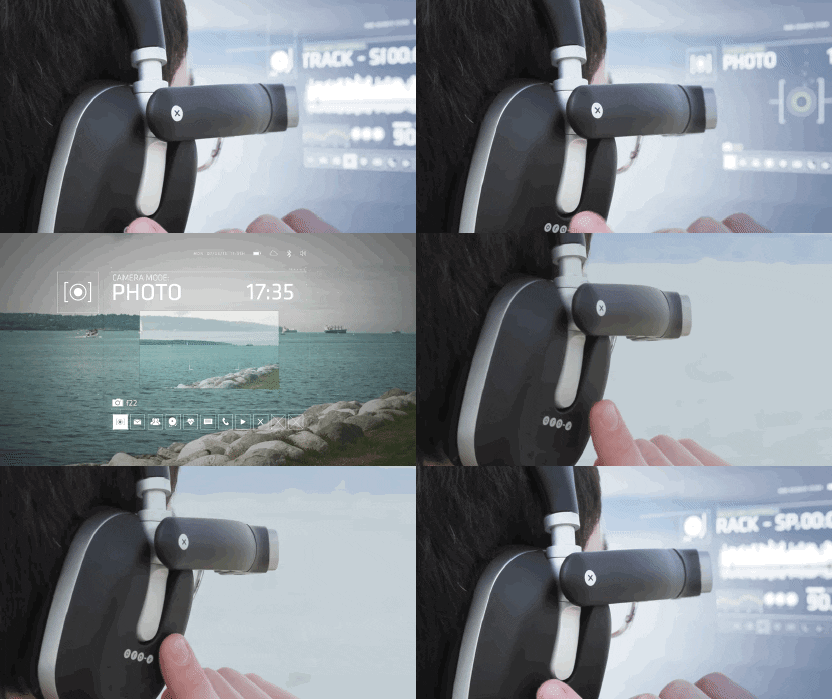
AR lenses aim to overlay digital information directly onto the wearer’s vision. In theory, they could magnify text, highlight edges or provide navigation cues. However, embedding a display into a tiny, curved lens is extremely difficult. Mojo Vision captured headlines when it demonstrated a 14,000-pixel-per-inch micro-LED display embedded in a contact lens at CES 2020. The prototype still needed to be connected to an external battery and processor. In June 2022, the company showcased a feature-complete lens with onboard power and communication, but it required extensive user testing.
In January 2023, Mojo Vision announced a major pivot. Its CEO explained that the slumping global economy and limited funding forced the company to shift focus to micro-LED displays, pausing work on the Mojo Lens. The company laid off about 75 percent of its staff and plans to revisit the lens project when market conditions improve. Similarly, Alphabet’s Verily division had partnered with Novartis to develop a glucose-sensing lens but suspended the project in 2018 due to inconsistent correlation between tear and blood glucose. These setbacks underscore the financial and technical challenges of AR lenses.
Light-Control and Adaptive Lenses
Beyond medical monitoring, some smart lenses aim to improve vision quality. Azalea Vision, a Belgian startup, developed the ALMA Lens, which includes an embedded diaphragm that dynamically adjusts the amount of light entering the eye. In December 2023, the company completed its first on-eye test. The lens uses liquid‑crystal technology, a microchip and a medical-grade battery to help patients with keratoconus, photophobia and presbyopia by filtering light and enhancing depth of focus. This functional iris concept could aid people with severe light sensitivity or iris disorders. While promising, the product is still in prototype stage and has not undergone large-scale clinical trials.
Current Status: What’s Available Now?
Despite media hype, only a few smart lenses are available to clinicians and patients today:
- Triggerfish (Sensimed) – A one-time-use sensor lens cleared by the FDA in 2016 for adults. It monitors fluctuations in eye volume to identify when to measure IOP.
- Theranostic IOP lenses – Research prototypes that combine IOP sensing with drug delivery are in pre-clinical stages.
- Drug-eluting contact lenses – Some lenses that release glaucoma medications like latanoprost have reached early human trials and show promise.
- Hydrogel sensor lenses (Purdue) – Lab prototypes can monitor IOP, glucose and neuromuscular signals while remaining comfortable.
- Adaptive light-control lenses (Azalea Vision) – The ALMA lens has completed initial on-eye testing for light sensitivity and presbyopia.
The broader contact lens industry acknowledges that smart lenses are still mainly in the lab. Contact Lens Spectrum’s 2026 market outlook notes that while augmented-reality prototypes will continue to appear, smart contact lenses are unlikely to move from lab to launch by 2026. There is still significant progress to be made, but no major commercial rollout is imminent.
Key Challenges Delaying Smart Lens Adoption

Developing SCLs is complex. Several hurdles must be overcome before these devices become mainstream:
Power and Energy Harvesting
Smart lenses need a stable power source. Current prototypes use batteries, inductive charging or energy harvesting from eye movements and tears. Batteries must be tiny yet safe; they cannot leak or heat up. Some researchers are exploring solar cells or biofuel cells that generate power from tear glucose. The challenge is generating enough energy without compromising comfort.
Comfort and Biocompatibility
A lens loaded with sensors, circuits and batteries must still feel like a normal contact lens. The MDPI review highlights that SCLs must balance functionality with comfort. Components should not obstruct vision or generate heat, and new biomaterials must ensure breathability and moisture. Hydrogels, graphene and other novel materials are being tested to achieve this.
Data Accuracy and Calibration
Health-monitoring lenses rely on accurate sensing. Tear glucose may not mirror blood glucose exactly; calibrations for each user are essential. Similarly, measuring IOP through corneal shape changes provides relative pressure changes, not absolute values. Better algorithms and calibration procedures are needed to translate sensor data into clinically meaningful information.
Connectivity and Privacy
Wireless data transfer must be secure. Smart lenses will likely transmit sensitive health data to a paired device or cloud platform. Companies must follow privacy laws and protect against hacking. There are also ethical questions about AR lenses that could record and transmit what a person sees.
Regulatory Approval
Health-monitoring lenses are medical devices. They must undergo rigorous clinical trials to demonstrate safety and effectiveness. The FDA’s approval of the Triggerfish lens shows that it’s possible, but obtaining regulatory clearance for more complex devices (especially those that deliver drugs or display information) will take years. Manufacturers must also address long-term biocompatibility and potential side effects like corneal irritation or inflammation.
Cost and Market Demand
Developing smart lenses is expensive. Mojo Vision’s pivot was largely due to funding challenges and uncertain market demand. For patients, cost is another factor. Will insurers cover these devices? Will consumers pay a premium for SCL features when cheaper alternatives like continuous glucose monitors or smart glasses exist? The answers to these questions will shape the market.
Potential Benefits and Future Applications
Though widely available smart lenses are years away, their potential benefits are immense:
- Continuous Health Monitoring: SCLs could track glucose, electrolytes, lactate and cortisol in tears, providing early warning signs for diabetes, dehydration, stress or infections.
- Personalized Medicine: By combining sensing and drug delivery, SCLs could automatically release medication when needed, improving adherence and reducing side effects.
- Assistive Technology: AR lenses could help people with low vision by enhancing contrast, magnifying text or identifying objects. Adaptive lenses like ALMA can reduce photophobia and improve vision in conditions like keratoconus.
- Neuromuscular Monitoring: Sensors embedded in hydrogel lenses may detect eye muscle activity, offering new ways to control computers or assist individuals with disabilities.
- Post‑operative Care: SCLs could monitor healing and detect complications after eye surgery, transmitting alerts directly to doctors.
Are They Actually Coming Soon?
Based on the current state of technology, smart contact lenses are not ready for widespread consumer use. Research advances rapidly, but the path from prototype to FDA-approved, mass-produced product is long. A major trade publication anticipates significant progress yet does not expect smart lenses to leave the lab by 2026. Major AR lens projects like Mojo Vision have paused due to funding challenges, and earlier attempts like Verily’s glucose-sensing lens were shelved because clinical results were inconsistent.
However, early devices such as the FDA-cleared Triggerfish lens show that regulatory approval is possible for simpler functions like IOP monitoring. Research groups continue to make breakthroughs in sensor materials, miniaturized electronics and power solutions. In academia and industry labs, prototypes are becoming more sophisticated. Expect incremental advances, with specialized medical lenses for monitoring or therapy available sooner than fully featured AR lenses.
What Should You Do Now?
If you’re excited by the idea of smart lenses, stay informed but manage expectations. For now:
- Continue regular eye exams. Early detection of glaucoma, diabetes and other conditions is still critical. Tools like portable tonometers and blood glucose monitors remain effective.
- Protect your eyes. Wear appropriate eyewear for your needs, whether that’s prescription glasses, conventional contacts or safety goggles.
- Follow news from reputable sources. Medical journals and official statements (like those from the FDA or major universities) provide accurate updates on SCL progress.
- Discuss options with your doctor. If you have glaucoma or other eye conditions, ask about existing home-monitoring tools like the Triggerfish lens or portable tonometers.
Actionable Takeaway
Smart contact lenses hold incredible promise, but they’re not ready for store shelves. Keep using proven methods to monitor your health and vision. Encourage research by staying informed and supporting organizations that prioritize innovation. One day, you may wear a lens that not only corrects your sight but also safeguards your overall health—but patience is key.
